Fiberglass Cloth Tape: 300°C Heat Resistance Explained

Where a film tape is chosen for thinness, glass cloth tape is chosen for strength. The woven fiberglass backing gives it mechanical toughness and dimensional stability that a plastic film cannot match, and the silicone adhesive lets it work across a wide temperature range.
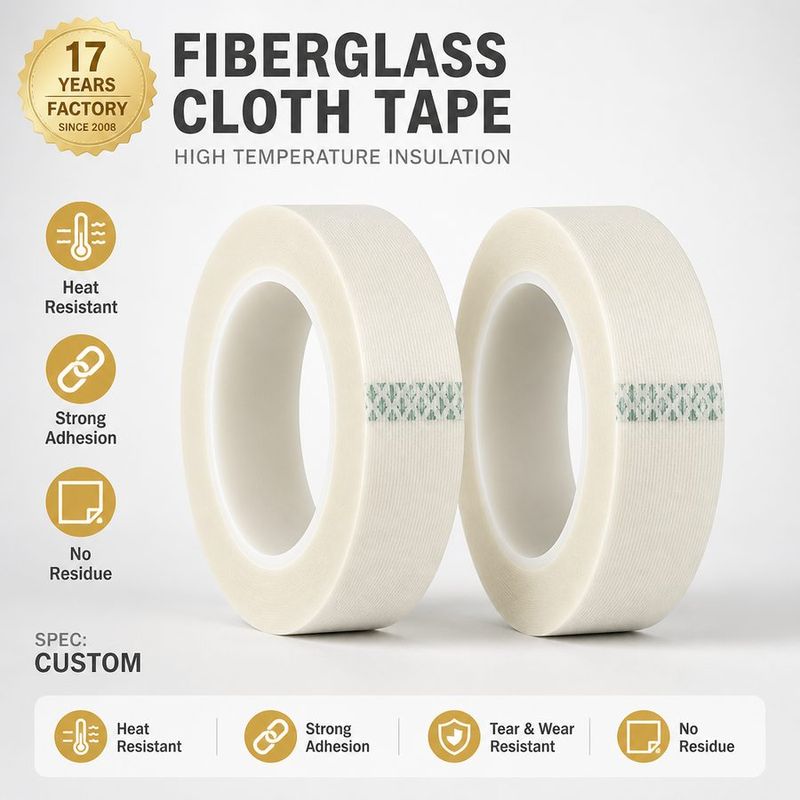
Where glass cloth tape is used
- Heat shielding and insulation wrapping — protecting pipes, cables and components near a heat source.
- Appliance and refrigeration repair — sealing and insulating where a heat-stable, durable wrap is needed.
- High-temperature masking — where the tape has to survive the process and still come away cleanly.
- Bundling under load — holding cable and pipe runs where a film tape would stretch or tear.
- Electrical insulation — a heat-stable insulating layer in equipment that runs hot.
What the woven backing changes
A woven glass cloth resists tearing in a way a film does not: once a film tape nicks, it propagates; a woven backing tends to stop the tear. That is why glass cloth is specified where the tape will be pulled, wrapped around a corner, or expected to hold a bundle in place.
It is also dimensionally stable under heat, so it does not shrink back and lift at the edges after a thermal cycle the way some films do.
Choosing between glass cloth and film
| If your priority is | Look at |
|---|---|
| Strength, tear resistance, holding under load | Glass cloth |
| Minimum thickness in a tight assembly | Polyimide or PET film |
| Release and chemical resistance | PTFE coated fiberglass |
They overlap in temperature range, so the deciding factor is usually mechanical rather than thermal.
Specifying it
Send the application, the temperature it sees, whether the tape is load-bearing, and the width you need. Glass cloth is converted to order, and the standard 0 to 300°C construction is listed on the fiberglass cloth tape product page.